This essay is an excerpt from my senior Honor’s Thesis I completed my senior year at Hobart and William Smith Colleges. The project was a 20,000-word photojournalism collection of essays and images detailing the experiences and personalities of the people behind the western New York chapter of the Rural and Migrant Ministry, or RMM, after spending my final year with the families and members of the group. The non-profit organization advocates for rural and migrant workers across New York while educating them of their rights and providing youth programs for their children. This was an interview with an undocumented family belonging to RMM.
Antonio and Juana welcomed me into their home and recounted the story of their journey from Mexico. Their young daughter, Itzel, joined us.
A pesar de todo
I typed in the address Miguel and Josefina had texted me a week earlier when we set up a time to sit down and talk. My phone told me it was 40 minutes away. I left early to stop and pick up some flowers, candy, and a stuffed animal for their young daughter. The drive, as I expected, was fully of gusts of snow, windy country roads, pickup trucks speeding past me illegally, and only two TRUMP 2020 flags.
The long, isolated driveway to their home was covered in a pure white blanket of snow patted down by some car tracks, probably from earlier in the day. I carefully navigated my car down the snowy driveway, narrowly avoiding getting my tires stuck in the ditch halfway down.
“Hi, I think I’m here but I’m not sure,” I said shyly in Spanish into the phone, parked in front of their house.
Josefina looked through the window and reassured me I was in the right spot. I scrambled out of the car with the gifts, my camera, and my notebook and entered their home.
There wasn’t much to their house, but there didn’t need to be as I was enveloped by its endearing atmosphere. Across from the door laid a pile of toys next to a TV, which was next to a bookshelf stuffed with books that I would soon learn occupied Miguel’s aspirations. From above the couch Jesus and Mary watched us, their portraits brandished on a flag that covered nearly the entirety of the wall behind me. Josefina led me to the kitchen table to begin the interview as I could feel the biblical figures’ guarding eyes behind us.
I told them I wouldn’t be recording the interview and they nodded in appreciation. They were already putting themselves at risk, allowing me to take their photos and write down the intimate details they would share with me as undocumented immigrants. Nonetheless, they bravely dove in headfirst to our conversation. After getting to know each other for a while, the deeper discussion began, and the air quickly became hotter with quickened Spanish to keep up with Miguel and Josefina. I started by asking where they were from and what brought them to this isolated, frigid part of western NY.
“Mexico,” Miguel answered immediately.
His and Josefina’s words began overlapping to describe the central part near Hidalgo that they were born in. I had never seen such effortless connection and unity between two people, with interruptions that flowed seamlessly into each other.
Josefina continued to say her sister knew people out here who could provide work, and so they followed the work. They had come here in 2000, when Miguel was 25 and Josefina was 20. They said goodbye to their parents and their close-knit families who had been by their sides until then, with only each other to hold onto from that moment forward. Miguel and Josefina were young, scared to leave their country, but they knew where they were was no place for the family and future they envisioned in their youthful dreams.
I was compelled to ask if they liked it out here, a place that could not be more different from Mexico. It was clear, though, that they had found peace here, decades after crossing into the U.S.
They answered yes, they did like it here, in a tone more enthusiastic than I expected. Miguel told me how much they love the different seasons. During the brutal winters like this one, he takes the kids sledding. His grin widened at the memories of pushing them down the hills through the snow he never encountered in his own childhood. Both of them truly seem to like the quiet and the peace awaiting them in the home at the end of that long driveway.
We kept going, and I asked them next what kinds of hardships they’ve endured. Miguel answered immediately, as though the word dificultad had already been subconsciously defined for him. He brought me back to when they first made the journey across the border.
“We left everything,” Josefina interjected as Miguel began the story. He nodded alongside her, exchanging glances as their shared story began to unfold. They admitted they were crossing illegally, fueled by the infinite possibilities that they imagined awaiting them in the U.S.
But I could sense when Miguel was thinking of hardship, it wasn’t just about the overall journey to get here. He had a story, a moment that was haunting him.
“They stole everything we had, all of the money we saved,” he said defeatedly.
“Who?”
“A group of five to six people. One had a knife,” Miguel made a stabbing gesture.
“One had a gun. Another was walking around with a hat,” he continued, his hands mimicking the collection hat.
They were stealing money from the caravan of immigrants they were with, a massive group of 50 to 100 people, Josefina told me.
“Were you scared?” I asked.
“Very, very scared.”
They were left with $20 of the thousands they had saved. I kept looking up at Miguel, staring at his eyes while he looked at Josefina. They had become redder, swelling with water, but no tears had fallen.
“I was three-months pregnant,” Josefina said suddenly, as though she had momentarily forgotten, and Miguel began nodding as though he just remembered too.
“With Carlos?” I asked, knowing he was their eldest son.
“Yes, with Carlos,” she said.
Nothing became easier from that day on. Miguel told me that life here was dramatically different; instead of finding a tight Mexican community or any sense of familial support that they had left behind, all they found was unforgiving competition.
“Instead of helping you, they see you as competition,” Miguel said, speaking of other immigrants who had sacrificed just as much to get to the same place.
“But there’s always someone to help,” he added.
Miguel spoke of their first job where they both had to walk an hour to work. No money, no license, no car, no choice. Josefina looked up at Miguel and started giggling a bit.
“Do you remember the old car that broke?” she said with a grin that lightened the heavy air.
Miguel started smiling too. The two of them were always on the same wavelength, carrying each other through the stories and difficult memories. They started laughing over this old car, the only car they could get their hands on. It had broken down—with no ID, they couldn’t get a license plate, so all they were left with was this old unreliable rust-bucket that should never have been on the road to begin with. And all they could do now was laugh about it, because what else would you do?
“It made us stronger,” Josefina said. It was a phrase that she held onto for the duration of our conversation.
“Out here, we’re isolated, alone,” Miguel told me. His tone somehow found a positive spin on the conventionally daunting descriptors.
I then asked what they do for work.
“Agriculture,” they responded almost completely in unison. New York is first and foremost an agricultural state, full of migrant and immigrant workers, so the answer seemed obvious. I wanted to know what other kinds of experience they had in the industry, given how central it is to the state’s economy.
“Apple, packing apples, potatoes and onions,” they clarified, piecing together the different jobs as they answered back and forth together.
“But we’ve worked in other jobs too,” Miguel continued. He worked in construction while Josefina had jobs in various stores. I asked them if they liked working in agriculture, where they still currently find themselves.
“Yes, we like it,” they said, nodding casually.
“The bosses are good,” Miguel said. Josefina interjected, “We wouldn’t want to do this all the time, though.”
I looked up from my notebook to ask what she meant by that.
She immediately answered for Miguel. “Real estate,” she said with a smirk as her gaze shifted to him. Miguel had no choice but to elaborate after that.
“If I could go back to school I would, to study finance,” he said.
He revealed he would not let go of his desire to learn, to grip those dreams to do more despite the content life him and Josefina had found.
Sabemos trabajar duro. We know how to work hard. They continually repeated that phrase, the words becoming tied to more than physical labor, as their mental strength resided at the core of everything they’ve surpassed and built in the past twenty years—and everything they hoped to achieve from that foundation of hard work.
But those dreams were set aside, as money quickly became the heart of everything for Miguel and Josefina out of the need to survive. Miguel gestured to the bookshelf behind me, saying how he would read financial books to set himself apart from the other immigrants he knows.
“It’s the mentality of immigrants, to come here, to earn, to spend,” he said.
He wanted to be different, to change the narrative. Miguel always had financial aspirations, something he felt he couldn’t realize in Mexico. Their words traveled back to 2000, when they were saving money after they arrived.
“The first week we were here, we didn’t have money for food, for clothing, for anything,” Josefina said. They had a debt to pay Josefina’s parents, who had sent them money after they were robbed at the border.
“We were focused on earning that money,” she said.
They were burdened with the pressure of her parents repeatedly asking when they would be paid, all while trying to build a new life from scratch, in their 20s, in a foreign country.
“It all went to expenses,” Miguel said. Josefina nodded next to him.
They didn’t want to be the elders they watched come back to Mexico after crossing the border, without money or the means to support themselves after a life of work. Most of all, they didn’t want to return to Mexico with empty hands and overworked bones.
As they thought about those elders, Josefina and Miguel began to think about themselves. They started to fear for themselves.
“In Mexico, you help your parents,” Josefina began. “You don’t do that here.”
She said it in a way that almost seemed like she was talking about me.
They were scared. Scared that their children wouldn’t take care of them one day, wondering if one day that would rest from the hard work, from el trabajo duro.
“They have the culture from here,” Josefina said, referring to her children, uncertain of what that may mean for her and her husband. I glanced at Miguel. His eyes were moving back and forth, from fixation on his partner to back down at the table.
Josefina admitted, “We don’t know, we don’t know if they will help and support us.”
They repeated Sabemos trabajar duro throughout the time they spoke of these fears. The words became reassurance that that’s what will sustain them, that hard work what will keep them afloat if their children could not.
Josefina’s parents came to stay with them for a while after their arrival.
“We depended on them for everything,” she said. They had a car and spoke more English, making them invaluable as Miguel and Josefina tried to navigate a daunting new lifestyle and language.
“When they left, the world ended,” she said.
“But it was better to be left independent,” Miguel cut in. They wanted to be able to cultivate something for themselves, to prove they were capable of it after already confronting some of the most unthinkable realities––realities that still have not left them despite all that they’ve overcome.
I pivoted the conversation towards the community they had found here, without that family by their side. Josefina told me that the Latinx population has grown a lot in the area. They’ve connected with the church full of people who look and speak like them, and of course the parties without which their lively culture would not exist.
It was clear that socializing was not a priority to Miguel and Josefina, though. All that mattered was that their kids found a community here.
“We aren’t very involved in their lives though,” Miguel said mournfully, “because of the language.”
Everything they have done and sacrificed has been for their children. Sabemos trabajar duro. They work harder and harder for their children but cannot witness the lives the kids have because of them. The only reason Miguel and Josefina don’t show up is fear. Fear that someone will speak to them in English, fear that someone will hear them speaking Spanish, fear that the wrong someone will hear them speaking Spanish.
With their sons Alberto and Carlos involved in Boy Scouts, sports, band, and choir, the guilt welled in Miguel’s eyes for not having been there for those meetings, games, and performances.
“It’s our status,” Josefina said, meaning immigrant status.
If they had it their way, they would stay home. When they see police cars patrolling, that fear grows and swells and builds until they know they’re in the clear. Josefina realized that fear was passed down to their children when their five-year-old daughter, Isabel, started to get scared of the police.
“They feel out of place,” she said, referring to the otherness that her children have subconsciously absorbed too as they’ve grown up in New York.
It pained Josefina knowing her daughter, still in kindergarten, resented her heritage as it set her apart from the white students populating most of her school. She told me that when Isabel came home from school, the internalized otherness manifested as five-year-old confusion and frustration.
“I’m different because of my black hair and I’m brown,” she told her mother, expressing inadequacy that no child should endure at such a young age.
Josefina told little Isabel, “You’re not white, but you were born here. The only difference is the language you speak.”
And Isabel could not express pride for that language. With a teacher that told her to speak in English and only one friend in class who spoke Spanish, she felt on the outskirts of a complicated social dynamic cultivated in a kindergarten classroom. When Isabel was told to speak English, she turned around and told her parents to speak English, believing this is the way life should be.
But then Josefina and I started talking about the beauty of Isabel’s bilingual knowledge. She told me how often she tried to remind her daughter of that, of how lucky Isabel was to know two languages.
“What role does RMM have in your lives?” I asked. That was where I met them, at a dinner far from their own home for which they were willing to risk the trip.
And as always, they do it for the kids. It’s a place where they can find community, young leaders, they told me. A space where they can be “more confident in themselves.” RMM is first and foremost for the rural and migrant workers, which include Miguel and Josefina, but the more we spoke, the more it made sense that they cared about what the community would offer for their children.
Miguel and Josefina didn’t like to leave the house much, as they’d told me, but they didn’t want that fear to reside within their children. They wanted Alberto to leave every Friday evening to join Wilmer at the youth group meetings.
RMM offered a place for the youth to “express their opinions––that will help them in the future,” Josefina said. “Carlos doesn’t have that at NYU,” she added.
“Almost everyone there is from the same culture,” she continued. I wondered if Isabel would go there too when she’s older, a place where she would have more than one Spanish-speaker around her and could be accepted for her dark hair and all. They spoke a bit about how RMM affected them, but it was abundantly clear they cared more about its presence in the lives of their children.
“We can go to that community,” Josefina said hesitantly, “but there’s less danger at home.” Menos peligro en la casa.
“There aren’t many Hispanic people here,” she told me. “We’re scared of new things, like this,” she said with a kind smile, gesturing towards my notebook.
“We avoid contact with others,” she said. For Josefina and Miguel, it’s better to be isolated.
As we continued, the conversation numbed the tired muscles in my hand while blood rushed to my tongue and ears to keep the Spanish flowing. I diverged from my pre-written questions, thinking about Isabel and the life she’s had here, about the political activism behind RMM, about all of the factors that come into their lives that likely cannot escape politics.
“Do the politics of the area affect you?” I asked them.
“Yes… they do,” Miguel nodded, mulling it over for a moment. They began speaking about Trump, how their already-existing fear as undocumented immigrants grew with the rhetoric blasting on televisions and brandished proudly by their neighbors. Fear of highways, of leaving the house, of police cars, of anything that hinted at ICE’s presence. Fear that they realized was not leaving anytime soon.
“It affects our self-esteem,” Miguel continued, thinking again of his children. They have had to grow up in a world, in a country, in a rural county that often rejects immigrants and Spanish-speakers out of a different kind of fear—one commanded by unjustifiable, racist hatred.
“They are already scared,” Josefina said, referring to Carlos, Alberto, and Isabel. Even though Miguel and Josefina are scared too, they want to shelter that fear from their kids. But they cannot be that shield when Isabel jumped at the sight of a police car or when Carlos and Alberto wonder if a day will come when they return home, but their parents do not.
When they arrived, they knew they needed to learn English in order to find work. And even with their energy divided between relentless hard work and stifling uncertainty, they found time to learn the language.
“We read these little books with basic English words in our free time,” Miguel recounted. Despite the never-ending work––between finding jobs on farms and spending every moment they could building that English vocabulary––their shared story became one they could laugh about in front of me.
In Spanish, sopa means soup, but when they first arrived to the U.S., Josefina and Miguel were still getting the hang of the language.
“We were ordering food,” Josefina said in between laughs, “and they brought us soap instead of soup.” They smiled at one another, having found joy in these little moments that pieced together the charismatic, kind, and hardworking parents in front of me.
Given that I had first encountered Josefina and Miguel at the Farmworker’s Dinner, where I was blessed with Josefina’s homemade beans and salsa, I was curious about what role food (comida) had in their lives and their culture. Here in New York, they don’t have access to the same fresh ingredients that they did in Mexico.
“We have to create it, but the food isn’t the same,” Josefina said of the ingredients she finds here.
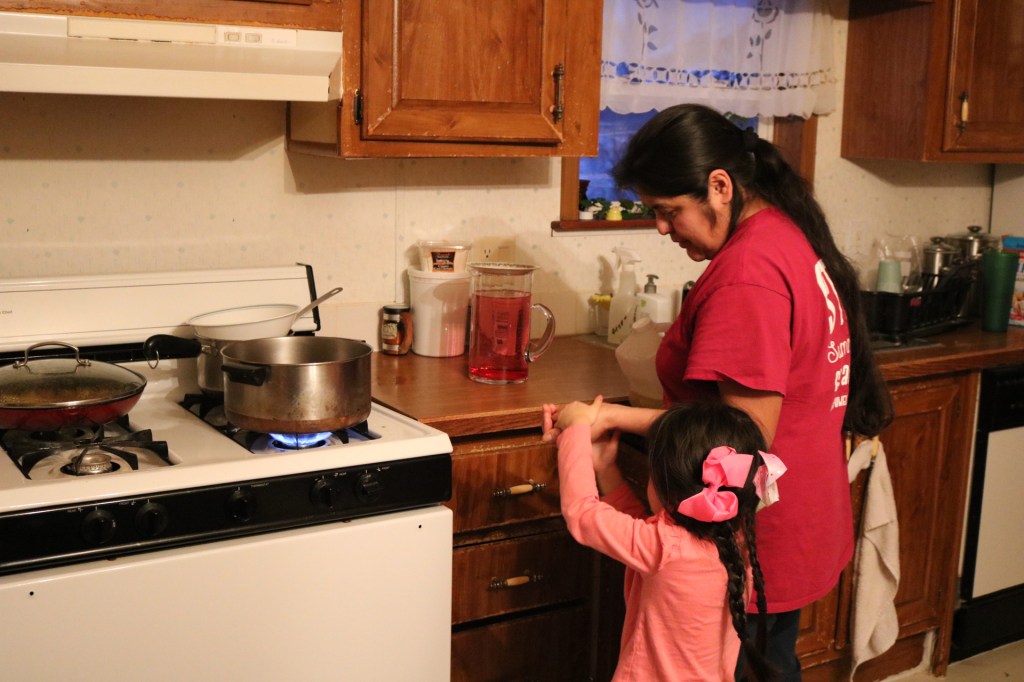
They had to leave behind the traditional Mexican cooking and reinvent their own by mixing with the “food culture” (if you can call it that) of western NY. This just made me even more curious about what they were up to in the kitchen. Josefina took on a sweet shyness as I pried further.
“Well,” she said, smiling bashfully at Miguel, “I make my style of ‘pizza,’ or fajitas from an American recipe—but using my own method.”
She told me about the traditional Mexican foods they’d left behind or have had to change since they’ve moved, like tamales, mole, enchiladas, chilaquiles, and of course Josefina’s delicious frijoles that I still think about (clearly).
I started telling them about how Josefina’s salsa was probably the spiciest I’d ever had that night at RMM, la salsa más caliente que he probado. She laughed in disbelief at my weak tastebuds while I let my pride suffer a bit.
Josefina and Miguel returned the conversation back to the fear that unfortunately dictates so many aspects of their life. The smiles were fleeting as they unable to hold onto them longer than a moment.
“We don’t know if we’re going to return home when we leave the house,” Josefina confessed. “If we could, we wouldn’t leave at all.”
But even their warm, secluded home doesn’t feel safe anymore. In 2012, around 6:00 one morning, they were awoken to banging on their front door. Men were circling their house, peering in their windows, searching for signs of life inside. Their children were terrified. Alberto hid underneath his bed. Josefina and Miguel refused to open the door. They don’t know what would have happened if they did, but they did know that ICE would have been waiting for them on the other side.
“El miedo es muy, muy real,” Miguel spoke softly, making it clear that this memory has never left them and likely never will. El miedo surrounds them just as ICE did, arising when they send their kids off to school on the bus, when they go shopping for food, or even when they’re at home, in their own property, where they don’t know who could come for them.
“11 million Hispanic people are in the same situation,” Miguel noted in a way that convinced me this statistic was burned in his mind.
And then there was silence.
I looked up across the table at Josefina. She was crying. I immediately put my pencil down and asked if she was okay, saying how we could stop, Podemos parar si quieres. She insisted on continuing.
“The fear is real… the memories… it’s hard living them over again,” she said through tears, still determined to keep talking.
“It makes us stronger,” she said. I don’t think she realized the sheer strength it took just to say that, let alone to endure the journey from Mexico to New York as a 20-year-old pregnant woman.
It was after Josefina began crying that I noticed how closely Miguel’s eyes were following my pencil. His gaze was tracing my Spanish letters as he continued speaking, but there was something guarded about his stare. Like he was protecting Josefina and his family as long as he knew what I was writing. I could feel the depth of their partnership the entire time, yet I could not stop thinking about the subtle threat his eyes presented as they carefully watched my hand scrambling to gather as much of their story as it could. But he always honored Josefina’s wishes, continuing as she desired, watching her carefully to let her know he was there with her just as he had always been.
Miguel remained quiet as Josefina’s broken voice was the only sound for a little while. As she insisted on carrying on, she kept talking until the tears faded into the background and the narrative was once again held firmly in her grasp. She brought me back to those early days of struggle, the ones that make her stronger to relive.
While her and Miguel scraped by trying to earn as much money as they could, they found employers who reduced their monetary troubles down to, Everyone has money problems.
They were in their 20s with a baby on the way and no possibility of seeing family back in Mexico. And they needed family as they battled the seemingly impossible debts and never-ending expenses.
“I miss my family more than Mexico,” Josefina said.
“It’s a much more familial culture over there, right?” I asked.
“Yes, very familial,” she answered. That support was she clearly needed when her and Miguel arrived, and still needed now amidst ongoing fear and uncertainty.
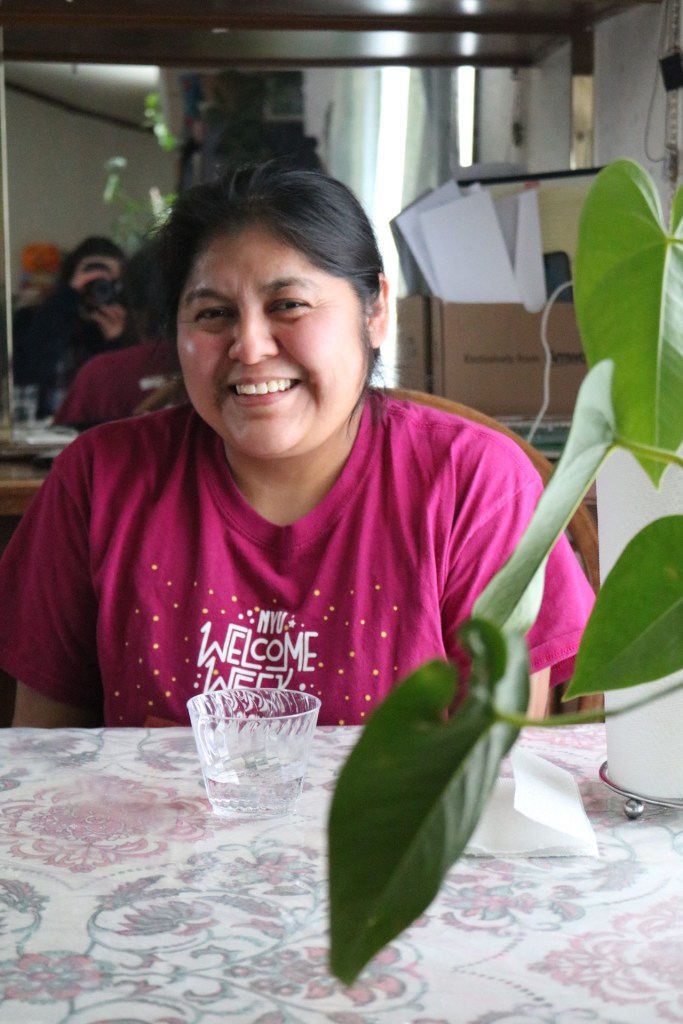
Mesmerized by Miguel and Josefina’s kindness and vulnerability, I suddenly noticed how perfectly the light was hitting the side of Josefina’s face. There was a plant between us, but it could not rupture the intimacy of the moment. She had her leg propped up and her right arm leaning against it, so delicately and casually. I wanted to freeze that moment, when she looked so at peace after shedding tears, her eyes locked onto Miguel’s as they started smiling at one another talking about something I couldn’t remember, likely Miguel’s attempt to bring her out of that sadness. Quickly the light was disappearing, as it tends to do in the dead of winter.
I paused before asking my next question to check and see if it was alright to take a photo of Josefina, hoping it had been enough time since the tears had faded. She seemed uncomfortable but still agreed. It was easier to speak than it was to be photographed as the reality sunk in that her smile would be attached to this story. The moment had passed as her leg fell back to the ground and her posture became more formal with the pressure of a camera in front of her now. She shyly smiled at me as I clicked the shutter, with charm emanating off of her for that moment just as it did with every word she spoke.
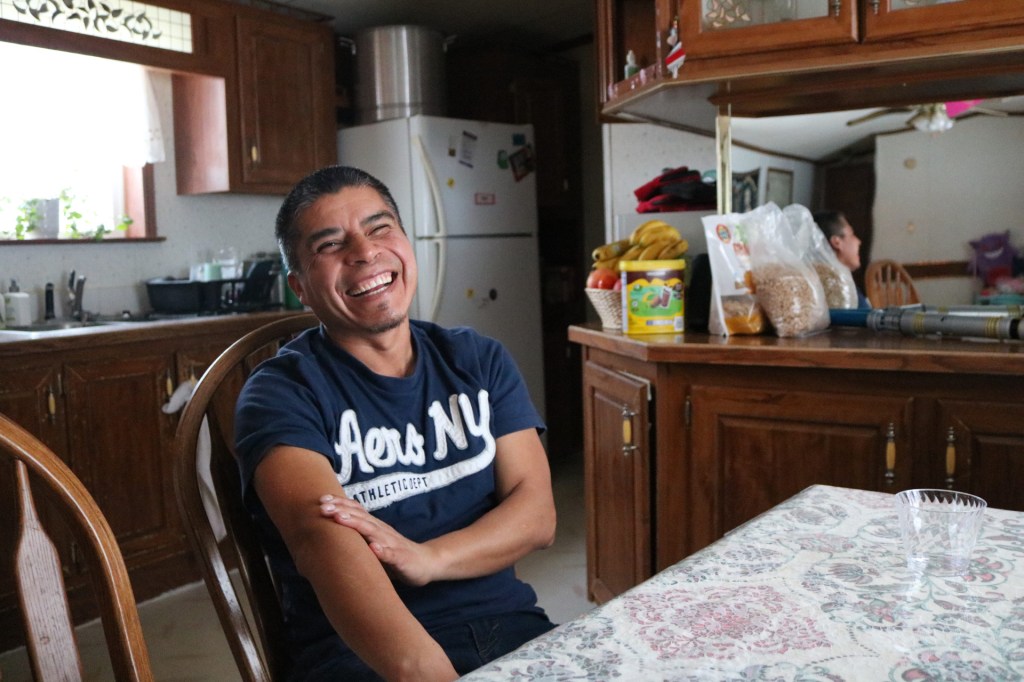
I turned to Miguel, still preoccupied with the fading light from the window. He was grinning brightly after watching his partner’s smile appear for me. Josefina was trying to get him to laugh (and succeeded) as I shifted my lens towards him. His smile covered his entire face while his entire body moved back in the chair, uncomfortable with the focus on himself but unable to stop the erupting laughter. I quickly pressed the shutter to freeze this moment, a time where Josefina had brought out Miguel’s joyful personality in an instant, something no one else but her would have been capable of. His eyes shifted between mine and the lens while I was taking photos, unafraid to let the camera and the people who would see these photos get a glimpse into this side of Miguel.
“What gives you pride in your lives?” I asked after taking the photos. El orgullo. A question that felt right to ask after the weight of the tears and the laughter followed. It was a question that wasn’t about pain or sacrifice, but about achievement, despite all odds.
Miguel knew what he wanted to say right away. Los hijos. Carlos, Alberto, and Isabel.
“In spite of the hardships,” he began, “the circumstances don’t matter.”
What matters is the future, getting better, mejorar. He was quoting a book he’d been reading, gesturing to the stuffed shelves behind me. Although Miguel and Josefina never had the opportunity to go to school themselves, all that matters to them is their children having that chance. The chance to get better, to grow, mejorar, to find their own pride. El orgullo.
“We’ve found personal improvement,” Miguel continued, “in the books.”
After reading about Abraham Lincoln, Miguel felt there was no possible way to compare his hardships to that of the Civil War president. Without a formal education, Josefina and Miguel still possessed the drive to learn and grow as much as they could on their own, inspired by the wisdom of others.
“We’ve found the will to move forward.” I don’t remember if Miguel or Josefina said this and I didn’t write it down, but I don’t think it matters much. They are a we, constantly moving forward together, beside one another.
In an instant, Josefina’s mind and body jumped at the same time as her arm reached out to Miguel.
“Your YouTube channel!” she said suddenly, hoping he would want to say more.
She had been thinking about pride, obviously more eager than Miguel to share as he uncomfortably shifted in his chair and hesitated to say much. He almost seemed embarrassed. Miguel finally started telling me about how he had set up a channel speaking about personal finance––in Spanish––to help people like himself feel in control of their money.
“It’s the Hispanic culture, to spend and work hard and spend without something to show for it,” he repeated. And he wanted to change that. From years of reading and studying finance, Miguel felt an obligation to give back to those 11 million immigrants in his and Josefina’s shoes. He knew what it was like to have an education that stopped at sixth grade, or to struggle with low self-esteem out of barriers to learning.
“Many don’t know how to write, to read––they can’t learn easily without that education,” he said. It’s more than the education itself, though.
“Racism changes us,” he continued. “We aren’t the example of learning, or the inspiration to be educated.”
Miguel hoped his channel would change that. He wanted anyone who watched it to know that they had options outside of agriculture and the jobs migrant workers often find themselves in.
And in 2004, Miguel acquired his GED, “despite all odds,” A pesar de todo, as he put it.
“How do you feel about telling your story to me?” I asked them.
Miguel admitted they were apprehensive at first, especially Josefina.
“But now we know we can trust you,” Josefina quickly added with a smile. Miguel then reminded me of those 11 million people that continuously occupied their minds.
“Our story is that of millions of people,” he said, “11 million,” Josefina added.
They also told me that I reminded them of Carlos, who had given them an appreciation of journalism through his own studies. And just like that, we were back at the beginning of our conversation, before I had begun taking notes and before we knew anything about one another. Hours earlier, we had talked about how journalism offers the chance to travel, to see people for who they are as you get to know them and their culture.
It was then that I saw why they wanted to do this interview, a pesar de todo, despite the pain and emotional labor it took to relive their trauma.
“What you’re writing, someone will read, and they’ll learn from it,” Miguel said. With those words, he put me at ease after hours of staring at my hands and the words escaping my pencil. It had always been about the 11 million people. And they were grateful to be able to speak to that.
“You’ve helped us,” Josefina said. She was so eloquent about showcasing that magnanimous heart hidden behind shy smiles and the long driveway leading up to their warm home. She said this interview gave them a space to tell their story and to keep overcoming the pain little by little.
“The United States is the land of opportunities,” Miguel said. “Politicians should realize that there have always been immigrants.”
Miguel knew that the country needs to receive life to grow, and the only way to grow is to work. The kind of work that often falls upon immigrants like Miguel and Josefina. They did not steal jobs from anyone or invade the country and culture. They were the ones taking the jobs no one wants, so others may have their wine, their apples, their stocked grocery stores. They’re thankful for this country, but that doesn’t mean the pain and fear are not still there.
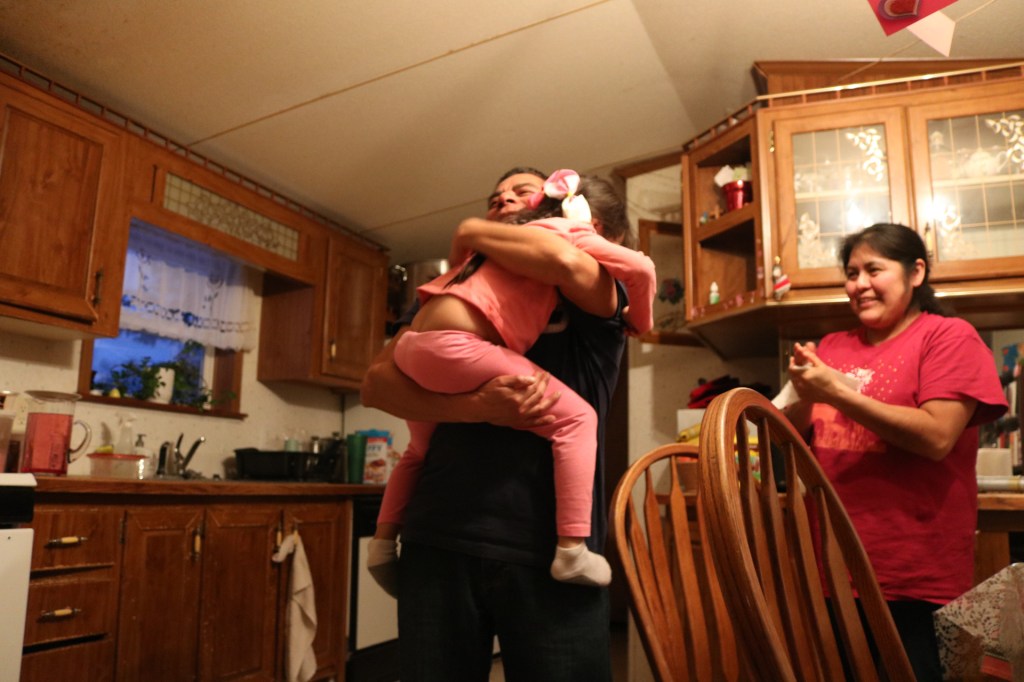
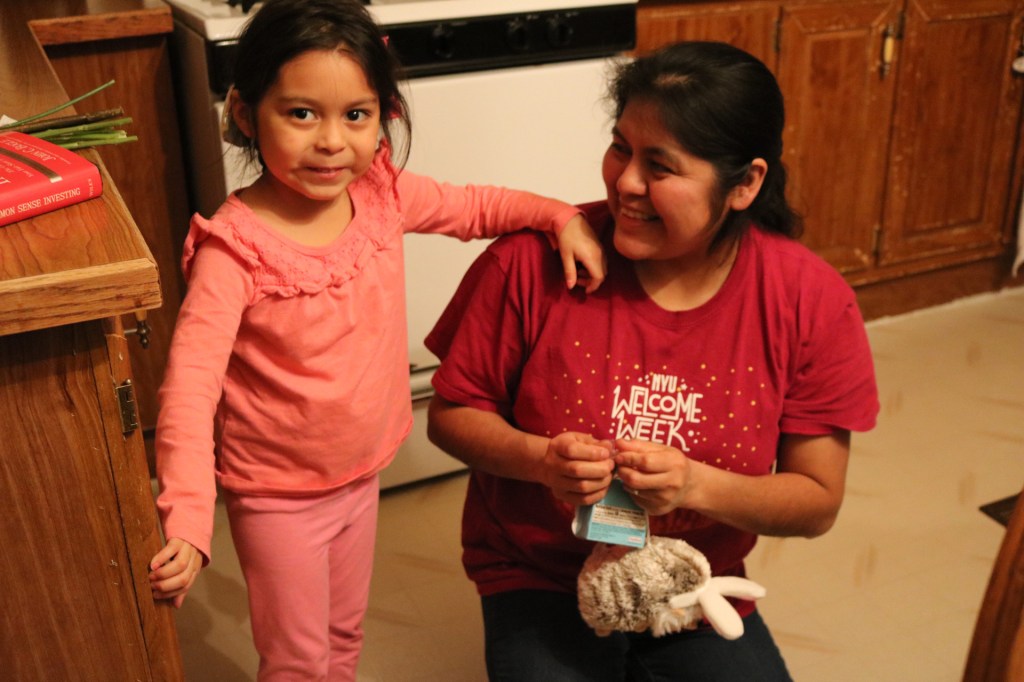
Isabel walked out right at that moment, frightful eyes looking me up and down and wondering who I was as she ran into her father’s arms. He scooped her up immediately and Josefina handed her the stuffed animal I had brought. Suddenly, her apprehension flipped. Now, she saw me as gift-bearer, and she wasn’t unhappy about that. The same girl who had pulled on her father’s hand to leave my presence the night we first met was now offering me a popsicle and giggling at my feet. We stood up from the table after sitting for so long, and Miguel immediately asked if I was hungry after we’d realized how late it had gotten. I wanted to stay but knew I needed to head out.
Josefina wouldn’t let me leave that easily, though.
They both insisted I stay until a batch of popcorn was done cooking, while Josefina packed up some homemade vegetable noodle soup for me to take (which I immediately devoured the second I got home). While the kernels popped, I handed little Isabel my camera. It was too heavy for her tiny fingers, so I held it up for her while I pointed to the button to take photos as her parents posed for a picture.
I have to admit, the five-year-old nailed it. She quickly turned the camera around on me to snap an image. She handed it back to me, leaving me to capture the sincerest moment of the three of them happily standing together in the kitchen (Alberto refused to come out of his room, in typical teenager fashion).
Josefina filled a massive Ziploc bag full of popcorn and handed me the soup. I thanked them more times than I could count, and they thanked me as well. We said goodbye as I stepped back out into the cold, icy snow.



 Ani Freedman, award-winning journalist