By Ani Freedman
Daniela Fernandez remembers telling her mother at the hospital, “It’s like I have two people inside my brain, and I can’t control what the other wants.” That was four years ago, when she was a 19-year-old patient at the New York Psychiatric Institute at the Columbia University Irving Medical Center. Fernandez found the program after her worried parents took her to the hospital back in Georgia, where doctors discovered a dangerously low heart rate and concerning vitals. Her muscles were weak, the heart most of all, after having been deprived of food for years as she had fallen deeper into her eating disorder.
Her parents drove her over 14 hours from their home in Atlanta to New York City on November 24th, 2018––a day Fernandez can’t forget, as it was the day before her brother’s birthday and the beginning of a five-month long treatment.
“It was either that, or letting myself die at home,” she said.
When Fernandez, 24, arrived in the U.S. in 2016, American beauty ideals were dominated by weight-loss teas, waist trainers, and having a perfectly hourglass figure with a flat stomach (and defined abs to follow). Her family moved to Georgia, leaving behind the comfort of relatives and the Colombian culture she had always known. She also left behind the place where her eating disorder began. As a child growing up there, she witnessed her favorite American television shows define beauty to be everything she was not: skinny, white, blonde-haired and blue-eyed. Herself and her peers idolized the young blonde pop stars and actresses on Disney Channel and Nickelodeon, many of them being able to see similar faces when they looked in their own mirrors.
But not Fernandez. Loneliness consumed her in her new home, with her parents working and her older brother off on his own. School offered no relief. Inside she was greeted by relentless bullying and being pushed to the outskirts of a culture she didn’t know, as she watched the images on television she grew up with come to life. She only felt more isolated, turning to the disordered behaviors that creeped in at her darkest moments, telling her being skinny was the gateway to feeling beautiful and accepted.
Eating disorders are the second deadliest mental illness behind opioid addiction in the United States, according to the National Association of Anorexia Nervosa and Associated Disorders. The COVID-19 pandemic saw a 48% increase in eating disorder hospitalizations, while the National Eating Disorder Association’s Helpline experienced a 58% increase in calls between March 2020 and October 2021. With roughly nine percent of the United States population predicted to experience an eating disorder in their lifetime, this life-threatening illness continues to put more people at risk––but for minority populations, the psychological toll manifests in a concerning, less acknowledged way.
Acculturation occurs when someone from a minority culture begins to take on aspects of a new, usually dominant culture such as European or American––and it’s considered one of the main risk factors for developing an eating disorder by the National Eating Disorder Association. Acculturated individuals may equate attractiveness with Western bodies that do not reflect their own––an aesthetic ideal born from a long history of thin white women being upheld as the epitome of beauty in American media and entertainment.
Dr. Anne E. Becker, founder of the Eating Disorders Clinical and Research Program at Massachusetts General Hospital, discovered that exposing Fijian women to American media and television for three years cultivated negative self-perceptions of their own beauty and bodies in her 2002 study. Many of these women, especially vulnerable younger women and girls, positioned themselves as inferior physically and culturally to the women they saw in American TV shows. Within the U.S., a 2006 study focused on Mexican American women found they were at greater risk of disordered eating due to an increased sociocultural pressure to be thinner the more they identified with American culture.
Studies of acculturation thus far have been limited, complicated by the various definitions of beauty within different cultures, generational differences and the rise of social media. Andrea Campillo, 18, lives in Mexico City and found Mexican culture to have pressured her to lose weight much more than American. “Everyone is fatphobic,” she said in Spanish, speaking of Mexican culture. “If you don’t have a specific body, they judge you––friends, family, society.”
Dr. Fary Cachelin, a psychology professor who led the study of Mexican American acculturation in women, found that younger generations (ages 18-30) tended to equate thinness with attractiveness more so than older generations (above age 30). While the study was based in the United States, Dr. Cachelin pointed out that you don’t have to be in a certain country to be exposed to its beauty standards––you can still be impacted, by say, watching American television as a young girl in Colombia, without even realizing it.
“If a girl doesn’t grow up with any media, how will she know that a blond girl is prettier?” Fernandez said. She hadn’t realized how influenced she was by Western beauty standards until she looked back on it––as a teenager, those standards became subconscious. “I was one of the few girls who wasn’t white,” she said. “I felt very inferior.”
Those feelings spiraled, as her desperation to fit in and lose weight gripped her tightly and she became fixated on the more pounds she could drop. “It becomes an addiction and something you cannot control anymore,” Fernandez said.
Fernandez was terrified to commit to the five-month treatment program at the hospital in New York back in 2018, but she recognized the harm this disorder was inflicting on her physically and mentally. Her first meal there, she was told she had to finish everything on the plate within 30 minutes. The nurses watched her carefully, making sure she wasn’t hiding any food––the hospital prohibited long sleeves for that exact reason––but she couldn’t bring herself to finish the meal, preoccupied with being perceived as “sick enough” to justify being there. Her psychiatrist warned her that she would be put on bedrest and lose her allotted time outdoors if she didn’t finish dinner and her snack that first night. She ate it all, still able to recall five years later the plate of spaghetti and turkey, with a sorbet for dessert.
In her time at the hospital, Fernandez became more aware of the “eating disorder voice” inside of her. She truly wanted to get better. “I would tell my mom, ‘It doesn’t allow me to get better,’” she said.
While she felt that other voice had become a part of her, it wasn’t always there. Before her eating disorder developed, Fernandez was an active kid. She played nearly every sport: swimming, tennis, dance, soccer, and so on. Her relationship with exercise changed, though, as she felt increasingly self-conscious about the way she looked, something she still struggles with now. Eating disorders, Fernandez said, hide within “gym rat” culture, which has become increasingly popular on American social media. She thought focusing on exercising, wellness, and all of the things that are deemed pinnacles of health would help her relationship with food––but it only kept her in her disordered mindset as she traded one obsession for another.
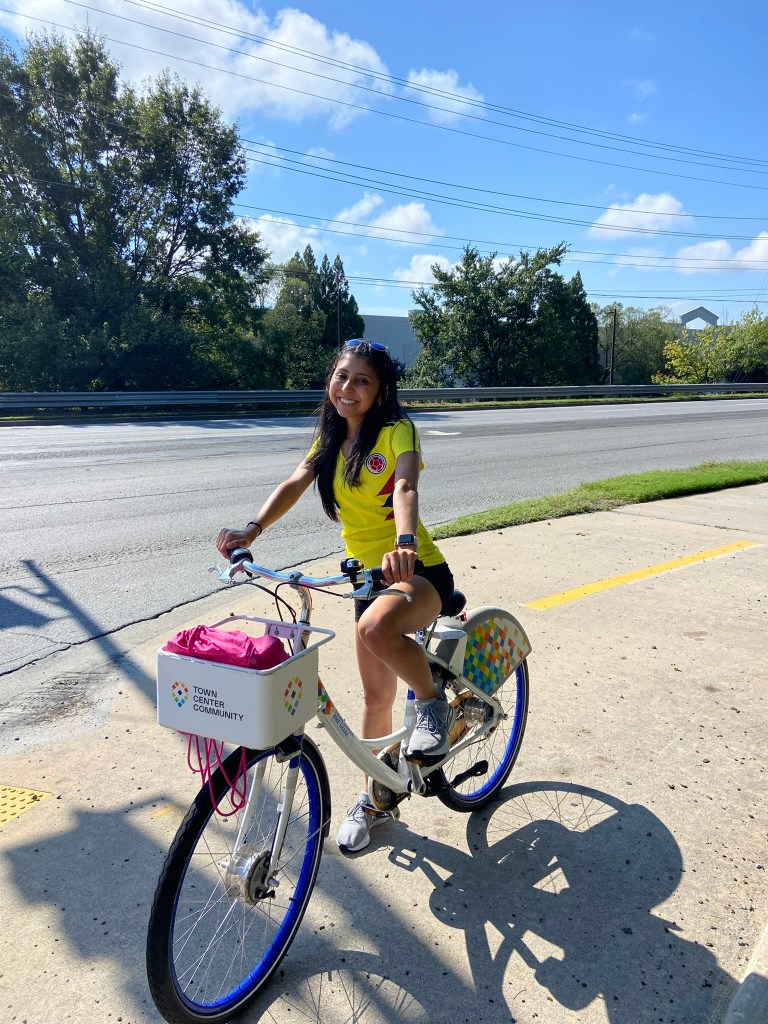
“Moving your body shouldn’t feel like a punishment,” Fernandez said.
Fernandez’s eating disorder was all about control, yet what often plunges people into those disorders is a lack of control––especially as someone becomes acculturated. She couldn’t help how much American media she was exposed to, her social media algorithms directing her towards certain influencers, or the Western ideas that dictated what beauty was. As a child, Fernandez couldn’t tell what was American influence and what was societal norm. She didn’t know if there even was a Colombian standard of beauty; all she knew was the popular, successful girl was the white, blonde, American girl.
As Fernandez grew up in Colombia, she noticed how different she was from her friends and the girls around her. She noticed the boys paid attention to the girls who looked like Disney stars––white, blonde––and not the girls like her, with darker skin, deep black hair and curvy bodies. She felt she truly looked Colombian, but that didn’t mean pretty for her at the time. Maybe she had internalized generations of colonial oppression, originating in Spanish colonization that positioned white colonizers above natives. And from those imperialistic roots, Colombia still lied under the influence of Western faces dominating young Colombians’ impressions of beauty and power through the media they consumed. Fernandez didn’t know the difference at the time. All she knew was that boys would approach her asking to talk to her friends, not her. She felt invisible. “I felt like I wasn’t pretty enough and I wanted to do something about that,” Fernandez said.
At age 15, still living in Colombia, she made a plan to lose weight. She began to restrict how much she ate, falling deeper and deeper into the mindset that weight loss was the only solution. As the numbers on the scale dropped, her weight loss was met with positive reinforcement. Boys began talking to her, friends and family would compliment and praise her for her discipline to eat less. Fernandez was convinced she was healthy and had a willpower others did not.
Every day, she would wake up and eat the same foods, using her scale to make sure they were the exact same weight. If one day she had 60 grams of tomato, then every day from that point on she had to have 60 grams of tomato. Everything was quantified and controlled; from the weight of her food to the weight of her body, to the numbers of calories she limited.
“Change was too scary for me,” Fernandez said. “Whenever something would pop up that would get in the way of that control, I would freak out, have panic attacks.” She couldn’t let herself rest, either; even though she couldn’t afford a gym membership, she had to keep her body moving constantly to burn more calories. She feared stillness. At night, Fernandez would go to sleep crying, her feet sore and her body exhausted from the nourishment it was being deprived of.
“Some nights I wouldn’t even want to wake up,” Fernandez said.
She didn’t want to go back to those exhausting, obsessive rituals of controlling everything she ate. In her journal, she wrote promises to herself that tomorrow would be better, that tomorrow she would not let the eating disorder win. The next morning, it was like another person was controlling her. The one that felt like she had to keep up those habits. She’d go to sleep full of regret again.
“It’s impossible to break just by yourself, it becomes a part of you,” she said. “You start thinking that’s who you are.”

Once it had become so ingrained in Fernandez’s daily life, her mind had convinced her that was who she was supposed to be, continuing the ongoing cycle of restricting her eating and being left in pain at the end of the day, trying to will herself to get better.
“I was not dumb, I was just very sick mentally,” Fernandez said. “I was so scared to lose that identity that I am the skinny girl and super fit and healthy.”
Before she made the choice to travel to the hospital in New York, Fernandez was fighting a seemingly unwinnable psychological battle with herself––alone. With no friends at school, she could only turn to her family, who couldn’t see the voice keeping her trapped in the disordered mindset. “None of them understand what I go through,” she said. “I still feel like my brother blames me for a lot of things that happened.”
Her mother tried her best, though. Fernandez says she was her “angel” while she was in the hospital. But as much as her family means to her, she said, they have never been able to understand the way her mind changed the deeper she fell into her eating disorder, the more she convinced herself that skinny was pretty, and the more she got used to depriving her body.
Fernandez got to know her mind through her doctors and nurses at the eating disorder treatment center. They helped her understand how the voice in her convinces her of what to eat and not to eat––while supporting her with a strict diet. Fernandez said there wasn’t room for any tricks she knows people with eating disorders often pull––hiding food, making up allergies and food sensitivities or convincing loved ones they aren’t hungry. Throughout the five months Fernandez spent in the hospital, celebrating Christmas in treatment and missing her parents’ birthdays, she found a community among the medical staff and other girls experiencing the same things she was. All of them were challenged by the steady increase in calories, going up to 4,000 calories in a day. But for Fernandez, her time there wasn’t about the food as much as it was about finally not feeling alone in this country. She cried when she left the hospital in New York, the only place where she had made true friendships and wasn’t bullied since arriving in the U.S.
Fernandez’s time in the hospital did not cure her eating disorder, but it left her determined to help others going through the same struggles. She felt more confident in herself, no longer the tiny, skinny version that she wanted to hide from the world. Through the isolation of acclimating to a new country, coping with bullying, and fighting an internal battle with her eating disorder, Fernandez has found her a support system while helping others who need it online. She transformed her Instagram account from a food diary to one where people could put a face and a voice to someone overcoming an eating disorder. “I had more to say than just showing people a picture of toast with banana on top,” Fernandez said.
She has become the voice for those who may not have others in their lives to comprehend what an eating disorder does to the mind, creating a community by sharing her 9-year struggle. She hosts a podcast and speaks to a combined 84,000-follower audience between TikTok and Instagram.
“I try to create the content that young Dani would need to see,” she said.
Across Fernandez’s Instagram are positive messages encouraging others suffering from eating disorders to pursue recovery. She speaks from experience when she tells her followers things like, “Losing weight won’t make you happier,” and “Gaining weight was and still is the best thing I could do.”
But she also remains transparent about her own struggles, letting them know that recovery isn’t perfect nor linear. “I went into fitness to try and find a solution for my ED… and it took me a little bit to realize that fitness isn’t recovery either,” she wrote in a post from August. “I was still trying to control every aspect of my body.”
While Fernandez has made it her mission to uplift people struggling as she has, she also has made it clear that she lives a life beyond an eating disorder or anything to do with how she looks. She’s an avid reader and cook, loves to learn and create new content, enjoys painting and going for walks. She no longer has the urge to restrict, and actually says she fears going back to her disordered habits. Now, she’s on a journey to understand her mental health while feeling a responsibility to help others by sharing her story and growing on her own. “I’m constantly reading and trying to be better for me and the younger audience,” she said.
On some days, Fernandez gets overwhelmed and wants to leave her social media behind, but then she remembers her time at the treatment center. “My main motivation at the hospital was wanting to help others,” she said. “It’s very different coming from someone who’s experienced it.”
On October 16, Fernandez posted a photo on her Instagram with the caption, “Every time I want to get back to the comfort of the ED, I get back to my values, my goals and my happiness and realize how much more there’s to life outside of the restriction cycle.” She was grinning and holding up an empanada.
 Ani Freedman, award-winning journalist